
Event Show Flow and Rehearsal Planning in Turkey
Contents:
- Turning an agenda into an operating document
- Cue authority and stage responsibilities
- Clock times, triggers and an illustrative cue table
- A rehearsal sequence with clear acceptance checks
- Multilingual hosts and speaker handovers
- Version freeze and change control
- Recovering time and checking readiness
Event show flow and rehearsal planning in Turkey should answer what happens between the sessions, not simply when each session starts. Someone must confirm that the speaker is ready, release the opening film, prepare the microphone and decide what the host says if the next transition cannot proceed. These decisions matter when a corporate meeting, awards programme or product presentation involves several departments and languages.
A usable run of show translates the client agenda into actions that the operating team can deliver. This guide covers that stage operation once the production concept is established. Use the Event Production Company Turkey guide for the wider delivery and responsibility model, and the technical production checklist for venue, equipment and infrastructure checks.
What event show flow and rehearsal planning in Turkey needs to document
Separate the guest agenda from the production rundown
A guest agenda may need only “opening address”. The operating document needs the host introduction, speaker entrance, microphone handover, screen asset, lighting state and next transition. Keep each row focused on a recognisable action. Long host speeches belong in a linked script rather than a cue cell that becomes difficult to read live.
Use matching segment codes across the rundown, host script and media list. Names, titles and asset references should match too. A unique film reference is more useful than “opening video” when the playback team has received several edits. Define abbreviations in a short legend so an incoming operator can understand the document.
Build around confirmed venue access
For a hotel programme in Antalya or Belek, confirm when the room is available, when service preparation takes place and when the venue needs it back. Do not treat installation complete and rehearsal ready as the same milestone. System checks, corrections and housekeeping need space between them. If another room booking or catering movement affects rehearsal, resolve that interface before the crew schedule is finalised.
Assign one cueing authority and visible handover responsibilities
Distinguish approval from live execution
Name the client representative who can approve programme and content changes. The show caller executes the agreed sequence with the stage, audio, lighting and video teams. A technical director assesses system constraints; a stage manager confirms that people and the entrance route are ready. Roles can be combined on a small programme, but each responsibility still needs an owner.
A host receiving one instruction while playback receives another can create two different shows. Route changes through the agreed decision chain and confirm their effect before the next cue. Authority to stop for safety must also be clear, following the venue and competent team's procedures rather than waiting for a creative approval.
Agree the calling language during rehearsal
Separate preparation calls from execution calls. A standby identifies what a department should prepare; the agreed go instruction releases the action. Confirm the wording, cue numbers and acknowledgement method with the actual operators. Keep the show channel brief, with routine coordination on another channel. Do not assume that an international crew interprets an informal expression in the same way.
Write the trigger as well as the planned clock time
A late speech should not invalidate every cue
Clock times support overall programme control. The actual release point for a film may be the host's final approved phrase, the speaker reaching a marked position or a stage-ready confirmation. Replace notes such as “after opening” with an observable condition. A scheduled time alone does not authorise an operator to interrupt a person-dependent transition.
Mark genuinely fixed anchors, such as a broadcast window or an agreed venue finish, separately from flexible segments. Identify who may shorten a section and which content must be retained. Allow for applause, walking and furniture changes when estimating durations. These are part of the programme even though they rarely appear in the guest agenda.
An illustrative cue table
The table below is a planning example for a fictional corporate opening, not a record of an AYT Events client project. Adapt its codes and language to the working conventions of the assigned team.
| Cue | Release condition | Action and hold option |
|---|---|---|
| A01 | Door and stage teams confirm ready | Caller releases opening sequence. If unavailable, hold approved arrival music. |
| V02 | Host delivers agreed final phrase | Playback starts opening film. If unavailable, host uses approved bridge script. |
| S03 | Film ends and speaker is ready | Stage entrance, speech light and microphone handover. If unavailable, maintain approved holding screen. |
| P04 | Speaker requests first slide | Playback reveals approved presentation. If unavailable, keep holding slide while backup is checked. |
Give each rehearsal a specific purpose and acceptance check
Start with a read-through, then test the transitions
A desk read-through can expose missing names, unclear cues and impossible handovers before the venue session. A cue-to-cue rehearsal can skip the body of long speeches while testing video endings, microphone changes, furniture moves and entrances in their actual order. Its purpose is to resolve dependencies before judging the rhythm of the whole programme.
A speaker's microphone and slide check is useful, but it does not test the full handover. A presenter may advance every slide correctly while the team still has no workable route onto a stage being cleared after a panel. Allocate rehearsal time according to transition complexity rather than speaker count alone.
Observe a continuous run without losing the evidence
A full run should include walking, applause allowances, language handovers and host links. Assign someone to log issues while the caller keeps the run moving, stopping for safety or a fault that prevents useful continuation. Afterwards, record each issue, its owner and the test required to close it. “Revisit transition” is less useful than “obtain stage-ready confirmation before releasing the entrance”.
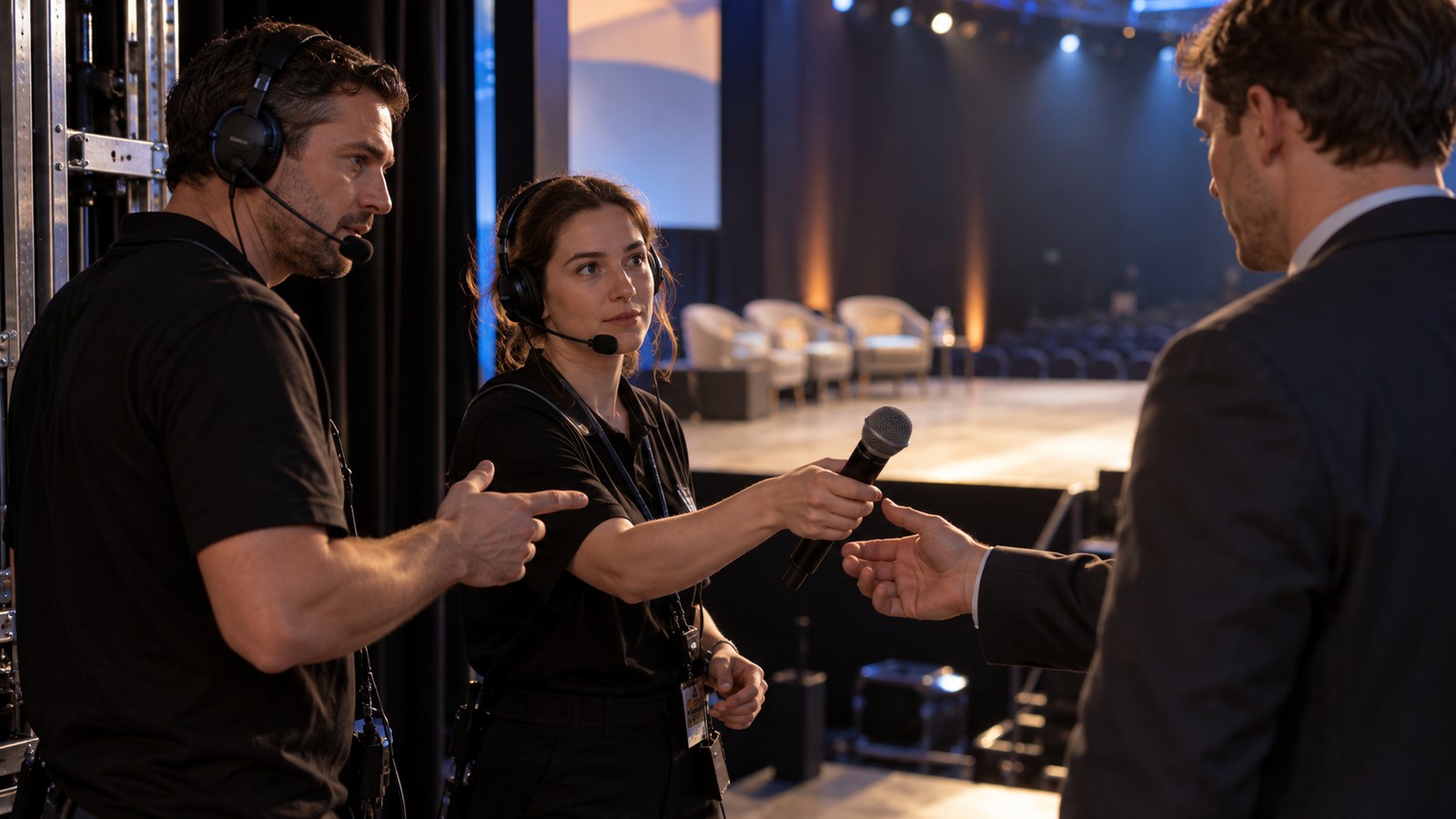 AI-generated illustration of coordination between a presenter, stage team and control position during rehearsal; not a photograph of a client event.
Rehearse multilingual hosts and speaker handovers separately
A language change affects more than the screen
When a Turkish welcome leads into an English presentation, the host introduction, on-screen title, speaker notes and interpreter materials should use the same approved names and terminology. Check pronunciations with the speaker or an authorised contact. A phonetic note is useful only after the person concerned has confirmed it.
Provide speeches, slides and key abbreviations to interpreters for preparation. AIIC's guidance for speakers explains the value of advance materials and clear delivery. Confirm whether interpretation is simultaneous or consecutive before locking durations: the two formats have different effects on the programme.
Use an approved short script to recover time
Read bilingual host links aloud in the actual language order. Do not assume that a paragraph takes the same time in each language. If time becomes tight, a prepared shorter link is easier to control than asking the host to speak faster, especially when interpretation is involved. Rehearse the return from an interpreted section to music, video or the next speaker too.
Freeze the working version and assess every later change
Give each asset an owner and an approval state
“Final” and “latest final” are unreliable file labels. Record a segment code, language, revision and approval status in the media register. Establish one master source for the rundown, script and asset list. Before doors, check that the control desk and any printed stage copies refer to the same revision.
Agree a content submission cut-off and a version freeze following rehearsal. Later changes may still be necessary, but they need a named approver and an impact check. Replacing a film can change the host link, running time, lighting transition and speaker entrance. Forwarding a file to playback alone does not complete that change.
Use a short acceptance chain
- Log the request against the affected segment.
- Obtain content approval and review the production impact.
- Check the file on the actual playback system.
- Confirm receipt of the revision with affected departments.
- Rehearse the changed transition where necessary and retire the old copy.
Prepare usable options for overruns and interruptions
Agree what can be shortened and where to resume
Discuss options such as reducing a question period, using a shorter closing script or omitting an optional film with the content owner in advance. Each alternative must identify the next valid cue. If a speaker is not ready, specify the holding screen and host wording rather than leaving the stage team to improvise an explanation.
For a safety stop or evacuation, follow the venue's emergency plan and authorised personnel. A show script is not a substitute for those procedures. During a technical interruption, the host should also avoid promising a recovery time that the technical team has not confirmed.
Make the final readiness check a shared action
- Do the rundown, host script and asset register match?
- Is the first speaker ready, with the required route and support?
- Have the show channel, backup communication and readiness calls been tested?
- Have timers and playback lists been reset after rehearsal?
- Does the team know the holding state, shorter script and approval authority?
Connect the operating plan to the agreed technical scope through the meeting equipment service, and review the company's project background through AYT Events references. This is a planning framework; assigned personnel, rehearsal access and deliverables should be confirmed for the individual event.
Explore AYT Events’ actual references and event delivery alongside this planning guide.
Selected AYT Events ReferencesExplore brands from different industries that have worked with AYT Events and view the wider project mix. | ||
 |  | |
 |  | |
 |  | |
| ||
See AYT Events projects on InstagramVisit @ayt.events for stage builds, gala programmes, corporate meetings and live moments from event delivery.
|
Event show flow and rehearsal planning in Turkey becomes useful when the agenda is translated into clear cues, tested transitions and named decisions. Share your draft programme, event languages, venue conditions and available rehearsal window with the AYT Events team to discuss what the stage operation requires.